Climate change: Scientific urgency and political non-action

There is persuasive scientific evidence that the Earth is warming and that human beings are largely responsible. Despite scientific evidence pointing to the need for urgent measures to reduce emissions, the responses by governments have been slow, muted and largely ineffective.

Why is there a mismatch between the apparent seriousness of the problem and our collective institutional response?

Is it because of entrenched actors such as fossil fuel companies or conservative voters who don’t believe in the reality of climate change? Are political systems such as liberal democracies ineffective or unable to solve complex societal problems?

What are some of the ways to create political action on major environmental issues?

This will be explored further in subsequent blog posts.

Some tips on how to handle those opinionated talkers

Are we at a point where everyone is trying to spread an opinion, but no one is really listening?

I am a listener. I have been quite surprised lately by the number of people I meet who unashamedly (with speed and ease) launch into controversial issues, often citing disproven facts and opinions.

Most issues we are dealing with in society are complex. For many people important issues such as the moral imperative to address climate change can be cognitively effortful to grasp. Attitudes on the environment can also fall along political lines, which fosters ideological polarisation and a sense of tribalism.

When confronted with strong opinionated people try and have a few good points. Keep it short. Unfortunately though, some people just like an argument – but at least the other person has to use ‘some’ listening skills when you’re speaking!

Bimblebox Nature Refuge: Nature not coal

The Bimblebox Alliance have successfully challenged Clive Palmers Galilee Coal Mine project, arguing it would cause irreversible environmental damage and unacceptable impacts to local agriculture.

Bimblebox Reserve on right; cleared grazing on left.

The Galilee Coal Project proposed roughly 50% of the 8000-hectare Refuge undergo large-scale clearing for two open-cut coal pits and four underground mines. The proposed mines would produce 40 million tonnes per annum of thermal coal over a life of 25-30 years, generating around 2.9 billion tonnes of greenhouse gas emissions.

Bimblebox Nature Refuge is a private conservation reserve (located 500km west of Rockhampton) with one of the largest tracts of intact woodland in Queensland. It is habitat for the endangered Black-throated Finch, the vulnerable Squatter Pigeon and the Near Threatened Black-chinned Honey Eater and Black-necked Stork.

Bimblebox is the first nature refuge to have applications for a mining lease and environmental approval challenged in court, and have them overturned based on climate and human rights grounds. This hopefully sets a precedent.

The Department of Environment and Science recently issued a media release stating the Land Court ruling, and that the department has decided to refuse the environmental authority application for the Galilee Coal Mine.

Eco-terrorism: Will it rise again?

To stop the destruction of the natural environment and more action on climate change, will individuals be increasingly drawn to radical environmental methods such as eco-terrorism?

Eco-terrorism is a misused and often misinterpreted term. It is an amalgam of civil disobedience, political activism and sabotage. Some academic writers have broadly defined it as ‘severe damage or destruction to property in defence of the environment, or to direct changes in environmental policy’.

Earth First! were one of the first eco-terrorist labelled organisations. Founded in 1979 in South-Western United States, the group went beyond tree-sitting protests to tree-spiking, cutting down billboards and pouring sand into the gas tanks of bulldozers.

The Sea Shepherd Conservation Society (who were labelled eco-terrorists by the FBI) used direct action against Japanese whaling vessels beyond the borders of the United States.

Often the actions of groups who are labelled ‘eco-terrorists’ rarely meet the working legal definition of ‘terrorism’ in Australia. However, it’s possible that groups in the future may use, or threaten violence as a mechanism. There is definitely anger and dissatisfaction among people and a growing interest in the anti-progress / pro-environment agenda.

Grove of Giants: Trees

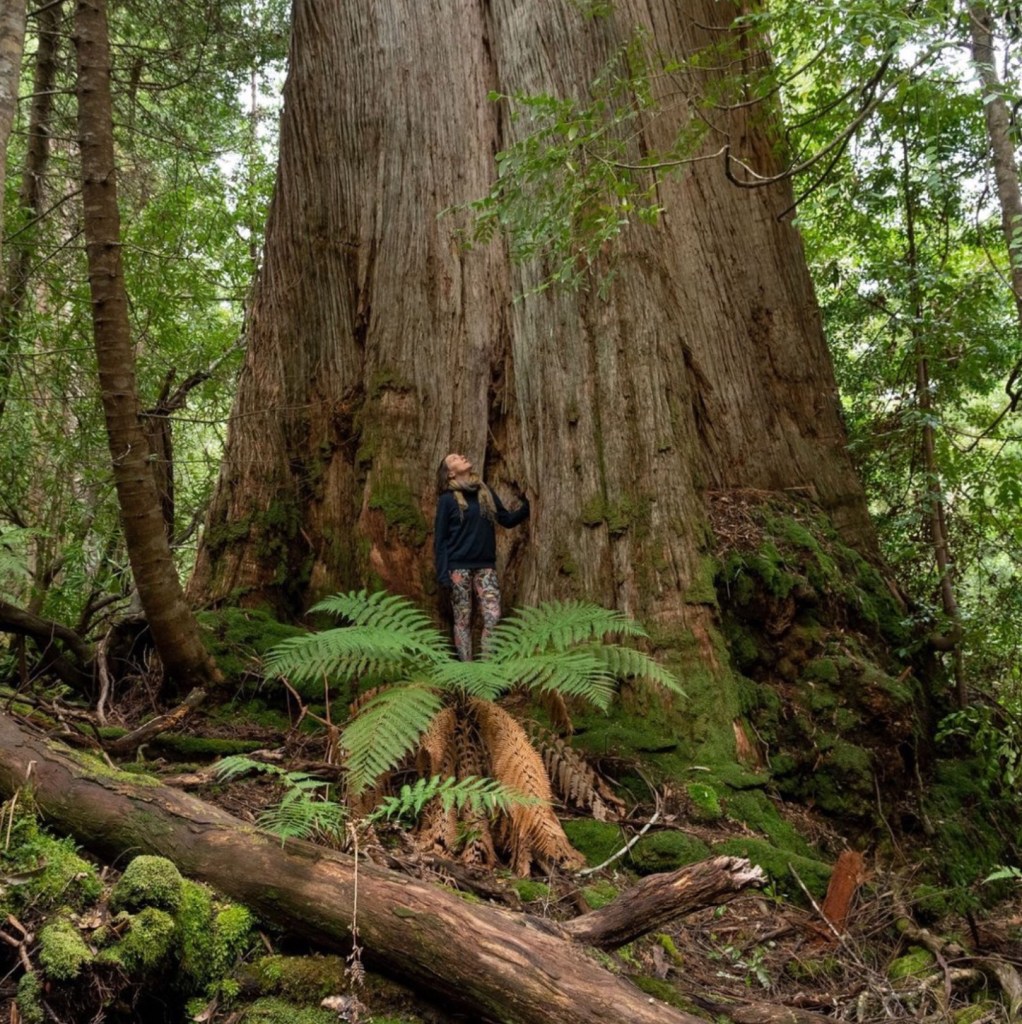
This is one of the biggest trees in the Grove of Giants in the Southern Forests of Tasmania. It is over 75m tall and is scheduled to be logged this year (2023) by Sustainable Timber Tasmania.

Photo courtesy of The Tree Projects

Sustainable Timber Tasmania manage Tasmania’s Permanent Timber Production Zone. The conservation of giant trees in these areas have little protection.

If you think giant trees in the Southern Forests of Tasmania should be preserved, then voice your concern to the following Tasmanian State government representatives:

  • The Tasmanian Premer: jeremy.rockliff@parliament.tas.gov.au
  • Tasmanian MP: felix.ellis@parliament.tas.gov.au
  • Tasmanian MP: roger.jaensch@parliament.tas.gov.au

More importantly, check out The Tree Projects for more engaging information, films, campaigns and research on big trees.

Competing Pressures on National Parks

Government agencies managing National Parks are required to balance a wide range of competing stakeholder interests and uses.

The most common pressures are between conservation, recreation and the local community.

For example;

  • Conservation of the natural environment – where human impacts in areas have been relatively limited, but are under increasing pressure to enable public enjoyment of the natural environment.
  • Recreation may also conflict with the interests of local communities. I.e Increasing visitor numbers to areas can create issues for locals such as overcrowding, traffic, noise and litter.

How do government agencies manage National Parks to include stakeholders interests whilst ensuring conservation principles are achieved?


Environmental Laws

Rather than focus on laws, how about we look more closely at how well they are being enforced and implemented? Environmental regulators are increasingly under resourced, incompetent and have a lack of incentive – especially when certain sectors have undue influence over decision-makers. Individuals, business, community groups and environmental professionals need to demand more from government.

Environmental Attitudes

National Parks and Marine Parks – we’re having so much trouble maintaining and funding these areas that are of ‘special value’ and ‘importance’. What does that say about our collective attitudes towards the environment?